




A broker’s advertised spread does not show the full cost of a trade from opening to closing. A fair comparison includes commissions, overnight financing and relevant account or currency charges, using the same position size and holding period for each broker. The result is an estimate you can test against your own trading pattern.
Calculate the full cost of a typical trade
Start with the costs directly tied to a position: the spread, any commission on opening and closing, and expected overnight financing. Add currency-conversion charges where they apply—for example, when trading costs are charged in a currency different from your account currency. A useful estimate is: round-trip trading cost = spread cost + round-turn commission + expected financing + applicable conversion charges.
For a simple comparison in pips, use: estimated cost in pips = spread in pips + round-turn commission divided by pip value for your position size. For EUR/USD, a standard lot is typically worth about $10 per pip when the account is denominated in USD. This is a working estimate, not a universal value: pip value depends on the pair, trade size and account currency. Confirm it in the broker’s contract specifications or with a position-size calculator.
Compare the same instrument, position size, account currency and holding period. A one-lot EUR/USD trade held for a few minutes is not comparable with a smaller position in another pair held for a week. Check whether published costs are quoted in your account currency, and account for the exchange rate used if you need to convert them. The aim is to keep your assumptions consistent, not to predict every fee precisely.
Compare spread-only and commission accounts with an example
Consider a standard-lot EUR/USD trade with a pip value of $10. On a spread-only account with a 1.0-pip spread, the spread cost is about $10 round trip, before financing. This assumes the quoted spread is representative when the position is opened and closed, with no separate commissions or minimum charges.
Now consider an account with a 0.2-pip spread and a commission of $3.50 per side per standard lot. The round-turn commission is $7. At a $10 pip value, that commission equals 0.7 pip, so the estimated total is 0.2 + 0.7 = 0.9 pips, or about $9. On these assumptions, the commission account is slightly cheaper before financing and other fees.
Repeat the calculation with the broker’s actual average spreads and commission schedule, rather than relying on minimum or headline spreads. A minimum spread may be available only in favorable market conditions; actual spreads can vary by time and volatility. Check whether commission is charged per side, per lot or per trade, and whether the stated rate is in your account currency. Also check for minimum commissions, which can change the effective rate on small trades.
| Account example | Spread cost | Round-turn commission | Estimated total |
|---|---|---|---|
| Spread-only, 1.0-pip spread | $10 | $0 | $10, or 1.0 pip |
| Commission account, 0.2-pip spread | $2 | $7 | $9, or 0.9 pips |
Match the comparison to your trade size and style
The same pricing can have a different practical impact at a smaller size. For a 0.1-lot EUR/USD trade under the example commission schedule, the pip value is about $1. Round-turn commission is $0.70, or 0.7 pip; adding a 0.2-pip spread gives an estimated total of 0.9 pips, or about $0.90. The per-trade cost is one-tenth of the standard-lot example, but the cost in pips is unchanged if pricing scales proportionally.
Scalpers and other frequent traders should focus on spreads and commissions because these costs recur on every trade. For example, a $1 difference per round trip adds up to $100 over 100 trades, assuming the same position size and no change in execution or pricing. This is an illustration, not a forecast: actual costs can vary with trade size, market conditions and order fills.
Swing traders should estimate financing over their expected holding period. Use the broker’s applicable long or short rate and rollover schedule, including any day on which a multiple-day charge applies. Then build a monthly estimate from your typical trade size, trade count and holding period. A low spread may matter less to someone who trades infrequently but holds positions for many nights. Financing may matter less to a short-term trader who closes before rollover.
Include overnight financing and CFD-specific charges
Estimate long and short financing separately. Brokers may charge different rates depending on whether a position is long or short, and rates can change with market conditions and the broker’s terms. Read the current instrument-specific schedule, note whether rates are shown as a cash amount, percentage or points, and check which currency the charge uses.
For a position held over several nights, multiply the applicable daily financing estimate by the expected holding period, following the broker’s rollover schedule. Don’t simply multiply a daily figure by the number of calendar days without checking how weekends and holidays are handled. Brokers commonly apply a multiple-day adjustment on a specified rollover day, but the day and calculation vary by instrument and provider.
For share, index and commodity CFDs, a forex pip-cost formula is not enough. Check the instrument’s contract size, financing basis, dividend adjustments and other contract specifications. An index CFD, for example, may have a cash financing adjustment and a separate dividend adjustment, while a share CFD may have financing based on the position’s notional value. A swap-free account does not necessarily eliminate holding costs: check for administration fees, eligibility rules and time limits.
Check fees outside the trade itself
Review deposit and withdrawal charges, currency-conversion markups, inactivity fees and account-maintenance fees. A broker may not charge for a particular payment method, but a payment provider or intermediary bank may. Check the terms for the exact method and currencies you expect to use; a fee-free deposit does not mean every later transaction is free.
Minimum deposits and minimum commissions can affect the effective cost, especially for small accounts or positions. If a commission has a minimum charge, calculate the actual fee for your intended trade size rather than applying only the advertised per-lot rate. Check whether currency conversion applies to deposits, withdrawals, realized profit or trading charges; repeated conversions can cost more than a one-off fee.
Prioritize the costs you are likely to incur. A rare withdrawal fee may matter less than a conversion charge applied to each deposit or trade. If you rarely move funds, however, a modest withdrawal charge may have little effect on your overall cost. Separate recurring charges from occasional ones and estimate each over a realistic period, such as a month or year.
Compare brokers using consistent evidence
Use average spreads for the instruments and trading hours you actually trade. Spreads can widen around news, the market open and rollover, so a daily average may conceal conditions that matter to your strategy. Compare similar periods where possible, and note whether figures come from live pricing, historical data or a broker’s published schedule. The low-cost trading brokers compared resource at ProForexBrokers can serve as an independent reference, but check current terms directly as well.
Execution conditions matter alongside quoted prices. The displayed spread is not necessarily the price you receive: slippage can make a fill better or worse, and order handling can vary by account type and market conditions. Review the broker’s order-execution policy, available order types and any stated restrictions. Where possible, assess actual fills over a consistent sample of trades, recording the spread at entry and exit, along with slippage and commissions.
Also verify the legal entity that would hold your account and the protections that apply. Check the regulator’s public register and confirm that the entity name and permissions match the account documents; the brand name alone may not identify the contracting entity. Client-money arrangements, leverage limits, complaint routes and compensation schemes vary by jurisdiction and account type. These are not trading costs, but they affect whether two otherwise similar offers are comparable.
Build a monthly estimate using your usual trade sizes, frequency and holding periods. Include spreads, commissions, expected financing, conversion and recurring account fees, then compare the total and its assumptions. Revisit the estimate when prices or fee schedules change, when you switch instruments or account currency, or when your trading pattern shifts.
Key takeaways
- Compare total cost for the same instrument, position size, account currency and holding period.
- Convert commissions into pips or money for your trade size before comparing account types.
- Include overnight financing and non-trading fees, not just the advertised spread.
- Treat broker comparisons as a starting point and verify current fees, spreads and execution terms directly.
Frequently asked questions
Is a zero-spread account always cheaper?
No. Add round-turn commission, financing and any minimum charges, then compare the total for your position size. A zero or very low spread can still mean a higher overall cost if the commission is large or other charges apply.
Should I compare minimum or average spreads?
Use average spreads for a realistic estimate, ideally for the instruments and trading hours you trade. Minimum spreads may be available only briefly and may not reflect conditions during your usual trading hours or when you open and close positions.
Which costs matter most for a long-term CFD position?
Overnight financing can outweigh the opening spread and commission. Estimate financing for the expected holding period and check instrument-specific adjustments, including dividend adjustments for relevant CFDs. Rates, rollover rules and other terms can change, so use the current schedule.
This article is for educational purposes only and is not investment advice. Trading leveraged products involves significant risk of loss.
6:00 am
Meeting Point
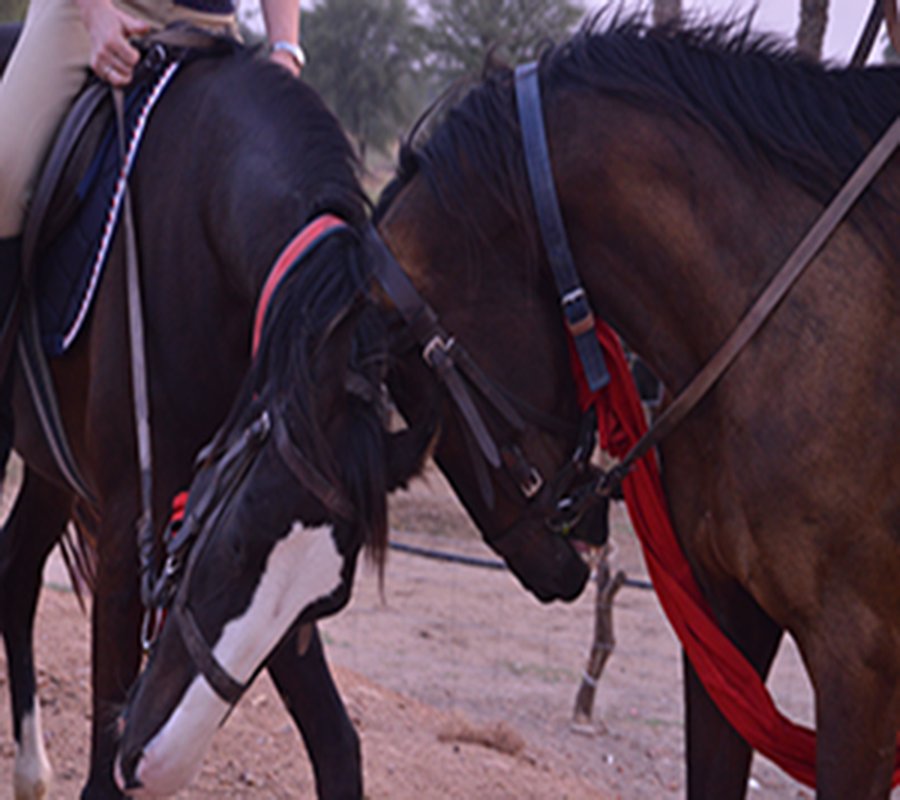 As soon as the light strikes upon the sky we meet at the Stud Farms which is just a short drive away from Jaipur, Get introduced to the ride captain, Perpetuating the deep insights about the exuberance of the village life and the traditional kinship of the rural Rajasthan, you are welcomed with the hot mesmerizing cut of traditional Indian Masala Chai.
Over the tea will discuss some of the dos and don’ts followed by the briefing about the ride, route and Horseback trailswe will be taking.
6:30 am
Prepare our horses
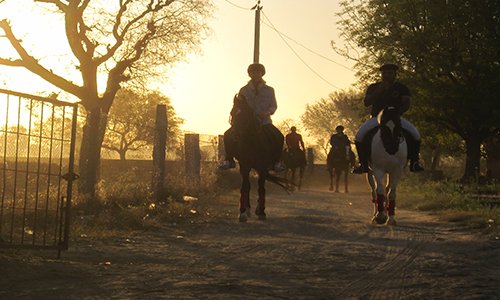
We prepare our horses to saddle them up with the essential equipment. We get time to familiarize ourselves with the Indigenous breed of Marwari Horseswhile practicing in the arena the tour leader will help us understand the some more unique features of Marwadi horses and how to ride in different styles, so you will be comfortable and confident with this exuberant Marwari horse for the entire adventure. [ /timeline_item]
7:00 am
The Ride Begins

The Ride Begins with slow walks through the pastoral paths, to master the walk it’s important to relax in the saddle. We trot on these pompous horses through the open fields as the cold breeze is brushing against us. Amidst the lush green fields, we take a short stop at a house for our horses to drink some water while we enjoy some freshly picked fruits from the fields and a hot cup of tea.
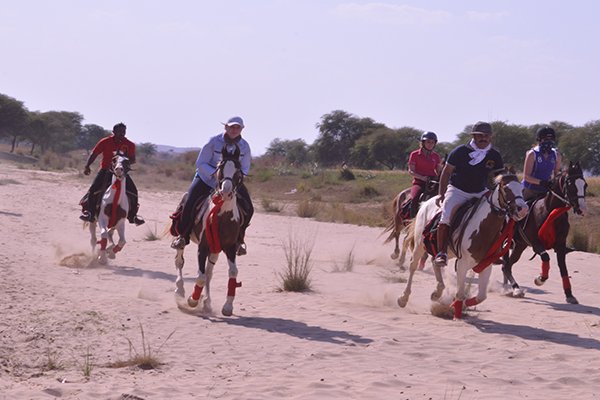
We then continue to ride through the village. In this beautiful morning, we will see how the rural India wakes up and continue their morning chores. We then get the horses canter into the sandy river beds heading into the village farmlands where the village folk are exhilarated at the sight of these majestic animals galloping through the fields. One may feel like regal Maharaja of the ancient era who has come to check if everything is running fine in his territory. Moreover, the ride in the countryside or to the off-beaten trails offer ample excitement.
After which we head out for a long trail in which we canter and gallop through the sandy paths and explore the exotic trails of the countryside of Rajasthan.
9:30 am
Ride back to the Stud Farms

Towards the end of this exquisite journey of Horse riding in Rajasthan countryside, we reach our Farms in breakfast time, Cheer up your horses before dismounting and enjoy the sight of horses wallowing on ground as we release them in the arena again, while the breakfast is being served we discuss the enigmatic tales and folklore that surrounds this area.
Extending the chitter-chatter we shall get ready to drive back to the Pink city with amazing memories and stories of horse riding tour to take back home.
As the lovely time spent with Marwari horses, we part ways with a souvenir for you to show your friends back home when you share your Rajasthan memories.
 Inclusions:
|
Terms and Conditions :
|
Package Cost
–INR: 12,500 Per Person
Minimum number of guests – 02


You May Also Like
Evening Heritage Walk Tour of Jaipur
"The Twilight Magic of Pink City" The
Ride to Galta Ji - (The Monkey Temple)
A Adventure Ride to Galta temple complex
Tour Reviews
An amazing horse safari
We had an excellent time in Jaipur with this tour company. Kush was excellent at communicating with us and escorting us to the farm. The horses were extremely well taken care of, beautiful Marwari horses with pointed ears. The farm itself was homely, everyone there was extremely welcoming and it felt like home. Dp hosted us and ensured everything ran smoothly, I couldn’t fault his hospitality and love towards the horses. more
The perfect day for a horse lover!
Khushal was incredibly helpful in setting up our day and making sure it was one to remember. We were traveling to India for my best friend’s 50th birthday and as she is an avid rider and lover of horses this seemed like the perfect adventure. more
Excelente paseo a caballo por las afueras de Jaipur
Disfrutamos mucho con el paseo a caballo. Los caballos son excelentes, de raza autóctona Marwari (Rajasthan).
Posteriormente visitamos un campo de polo y pasamos un magnífico rato. La atención y el desayuno fueron fenomenales. Khush es un excelente anfitrión. More
While in Rajasthan we (my husband and I and our two girls of 14 and 12) were keen to try and find a place to ride. It would have been wonderful to go for some days on a horse safari, but we hadn’t much time, so settled this time on going for a shorter ride. I’m so happy we came across Khush at Le Tour de India and DP Bana and his stud farm. We were taken in as friends to join a wonderful morning ride through villages and fields outside Jaipur. It was a completely different and wonderful experience to ride the sensitive, spirited and forward-going Marwani horses. Much care was taken by the captain leading the ride to ensure that everyone was managing with their mounts. When we returned after a great ride we sat under the canopy to enjoy a lovely spread for breakfast, and then had a great time getting on a couple of the fantastic polo ponies they have at the stables, and trying to play some polo – so much fun! Aside from the wonderful horses and riding, what also made this such a special experience was the warmth and friendliness of all those involved. Khush from Le Tour de India, who organised the morning ride was as helpful as it’s possible to be. I had mentioned to him when we were organising our trip that we’d love to see a polo match while we were in Jaipur, and he written back to say that the season was unfortunately over. But the day we arrived in Jaipur he wrote and surprised us by saying that he had set things up for us to go and watch a match that evening! Great fun to go to the polo ground and take it all in. DP Bana, who met us and looked after us like family at the polo match and the next day at his stud farm from where we went on our morning ride, was just so generous and warm in including us and introducing us to his friends, who also joined us the next day for the morning ride. Altogether very special, as it felt as though we made a real connection with each other in just a short time. Way over and above the usual tourist experience. Thank you all. Very much hope to see you again.
Leave a Review