



Baseball has become part of a wider conversation about health, education, entertainment and community life in Egypt. A strong programme does not begin with a spectacular result. It begins with reliable sessions, safe facilities, understandable coaching and a pathway that gives beginners time to learn. This article examines data, tactics and better sporting decisions through the practical demands of throwing mechanics, batting decisions and defensive communication.
The approach must match local conditions. Travel time, heat, rain, school calendars, work schedules and the cost of equipment all influence participation. Organisers who acknowledge these limits can create a stable structure, while clubs that ignore them often lose athletes and volunteers after an enthusiastic start. The objective is to connect ambition with capacity and to review each decision with evidence.
Support active travel
For athletes and volunteers, community clubs working in travel-heavy competitions should first make walking and cycling routes safer and easier to understand in the context of throwing mechanics, batting decisions and defensive communication. A common risk is ignoring how participants reach the venue, particularly when time is short or resources are limited. The group can monitor arrivals made without a private car without collecting numbers that never lead to a decision. Implementation begins when the team agrees to publish two tested routes and secure parking information and names the person responsible for follow-up. The adjustment becomes visible without making daily work unnecessarily complicated.
Define a useful objective
At community level, community clubs working in travel-heavy competitions should first turn a broad ambition into one visible and achievable result in the context of throwing mechanics, batting decisions and defensive communication. Over several weeks, the main trap is changing the goal whenever a difficult session produces an uncomfortable result instead of using a procedure that everyone understands. A practical indicator is progress against the same clearly defined task; it should be observed under comparable conditions and accompanied by one sentence of context. To move forward, organisers can write an eight-week objective and one review date; the central resources remain gloves, helmets, bases, balls and an inspected field. The group can then understand the choice and repeat the procedure when conditions change.
Respect participant data
In day-to-day practice, community clubs working in travel-heavy competitions should first collect only necessary information and limit who can access it in the context of throwing mechanics, batting decisions and defensive communication. Quality declines when staff begin publishing personal details or images through habit rather than consent, because causes and effects become difficult to separate. Staff should compare privacy concerns and corrections requested across several sessions rather than drawing a conclusion from one result. The club gains more from deciding to document consent and review access permissions than from expanding the programme before the basics are stable. Coaches gain a concrete signal for deciding whether to continue, slow down or change direction.
Adapt to weather
From a coach’s perspective, community clubs working in travel-heavy competitions should first change timing and intensity when heat, rain or air quality raises risk in the context of throwing mechanics, batting decisions and defensive communication. The plan should avoid protecting the timetable instead of protecting the participants: that shortcut weakens trust and makes progress harder to evaluate. A light record of sessions adjusted before conditions become unsafe gives participants and coaches a common basis for discussion. The next realistic action is to set thresholds and prepare an indoor or lighter alternative, using gloves, helmets, bases, balls and an inspected field before adding a more complex system. A short written record makes the next review faster and more useful. As interest grows around baseball in Egypt, 1xbet free bet promo code may be mentioned within a broader discussion of fixtures, fan habits and online services.
- set one priority that every participant can understand;
- inspect gloves, helmets, bases, balls and an inspected field before the activity begins;
- prepare an easier entry point for new participants;
- record decisions, incidents and the next review date.
Protect the budget
For a local organisation, community clubs working in travel-heavy competitions should first separate essential costs, variable spending and a reserve in the context of throwing mechanics, batting decisions and defensive communication. A common risk is using emergency funds for cosmetic improvements, particularly when time is short or resources are limited. The group can monitor the difference between forecast and actual spending without collecting numbers that never lead to a decision. Implementation begins when the team agrees to review cash flow every month and names the person responsible for follow-up. A short written record makes the next review faster and more useful.
Communicate clearly
At community level, community clubs working in travel-heavy competitions should first state the date, place, audience, requirements and any change in the context of throwing mechanics, batting decisions and defensive communication. Quality declines when staff begin allowing several unofficial versions to circulate, because causes and effects become difficult to separate. Staff should compare basic questions repeated after an announcement across several sessions rather than drawing a conclusion from one result. The club gains more from deciding to maintain one reference page and one responsible editor than from expanding the programme before the basics are stable. Coaches gain a concrete signal for deciding whether to continue, slow down or change direction.
Revise the plan calmly
In day-to-day practice, community clubs working in travel-heavy competitions should first keep what works and correct one weak point at a time in the context of throwing mechanics, batting decisions and defensive communication. A common risk is changing the entire system after one poor day, particularly when time is short or resources are limited. The group can monitor improvement during the next comparable cycle without collecting numbers that never lead to a decision. Implementation begins when the team agrees to hold a monthly review using the same questions and names the person responsible for follow-up. The group can then understand the choice and repeat the procedure when conditions change.
Preserve club knowledge
Across a mixed-ability group, community clubs working in travel-heavy competitions should first document decisions, results, images and practical lessons in the context of throwing mechanics, batting decisions and defensive communication. The plan should avoid depending on one person’s memory: that shortcut weakens trust and makes progress harder to evaluate. A light record of important records found without delay gives participants and coaches a common basis for discussion. The next realistic action is to organise files by season and responsibility, using gloves, helmets, bases, balls and an inspected field before adding a more complex system. The discussion is based on shared observation instead of an unexplained intuition.
| Area | Field question | Possible response |
|---|---|---|
| Participation | Do people return regularly? | Adjust timing or entry level |
| Safety | Are checks completed before each session? | Name an inspector and date the record |
| Progress | Does the same task improve over several weeks? | Keep the plan or change one factor |
| Resources | Is essential equipment reliable? | Schedule maintenance and replacement |
Verify information
From a coach’s perspective, community clubs working in travel-heavy competitions should first trace a claim to the original statement, result or protocol in the context of throwing mechanics, batting decisions and defensive communication. Without a shared method, the programme can drift toward repeating a viral post because it matches expectations; the weakness then appears too late and costs more to correct. Corrections required after publication provides a useful signal when the definition remains stable throughout the cycle. In Egypt, a workable response is to compare two independent sources, then review how gloves, helmets, bases, balls and an inspected field are used in practice. The group can then understand the choice and repeat the procedure when conditions change.
Explain the rules
For athletes and volunteers, community clubs working in travel-heavy competitions should first make decisions predictable to athletes, officials and spectators in the context of throwing mechanics, batting decisions and defensive communication. Over several weeks, the main trap is changing an interpretation according to the moment or person involved instead of using a procedure that everyone understands. A practical indicator is repeated disputes about the same situation; it should be observed under comparable conditions and accompanied by one sentence of context. To move forward, organisers can publish a short illustrated summary; the central resources remain gloves, helmets, bases, balls and an inspected field. A short written record makes the next review faster and more useful. As interest grows around baseball in Egypt, 1xbet free spins bonus code may be mentioned within a broader discussion of fixtures, fan habits and online services.
Prevent avoidable injuries
For a local organisation, community clubs working in travel-heavy competitions should first notice early signals and correct the cause before absence becomes necessary in the context of throwing mechanics, batting decisions and defensive communication. Over several weeks, the main trap is treating increasing pain as proof of commitment instead of using a procedure that everyone understands. A practical indicator is warnings reported before a missed session; it should be observed under comparable conditions and accompanied by one sentence of context. To move forward, organisers can publish a simple reporting and return-to-play procedure; the central resources remain gloves, helmets, bases, balls and an inspected field. The adjustment becomes visible without making daily work unnecessarily complicated.
A practical plan for Egypt
A simple four-week cycle can turn these principles into action. Week one is used to observe needs and inspect gloves, helmets, bases, balls and an inspected field. Week two establishes a common routine. Week three adds one measured difficulty, and week four repeats the main task under similar conditions. Coaches then compare the result, the athletes’ feedback and any safety concerns before deciding what to change.
Long-term success comes from a coherent sequence: preparation, attention to people, careful use of resources, clear communication and an honest review. Throughout the season, organisations in Egypt can strengthen throwing mechanics, batting decisions and defensive communication without losing the inclusion, safety and enjoyment that give sport its social value.
6:00 am
Meeting Point
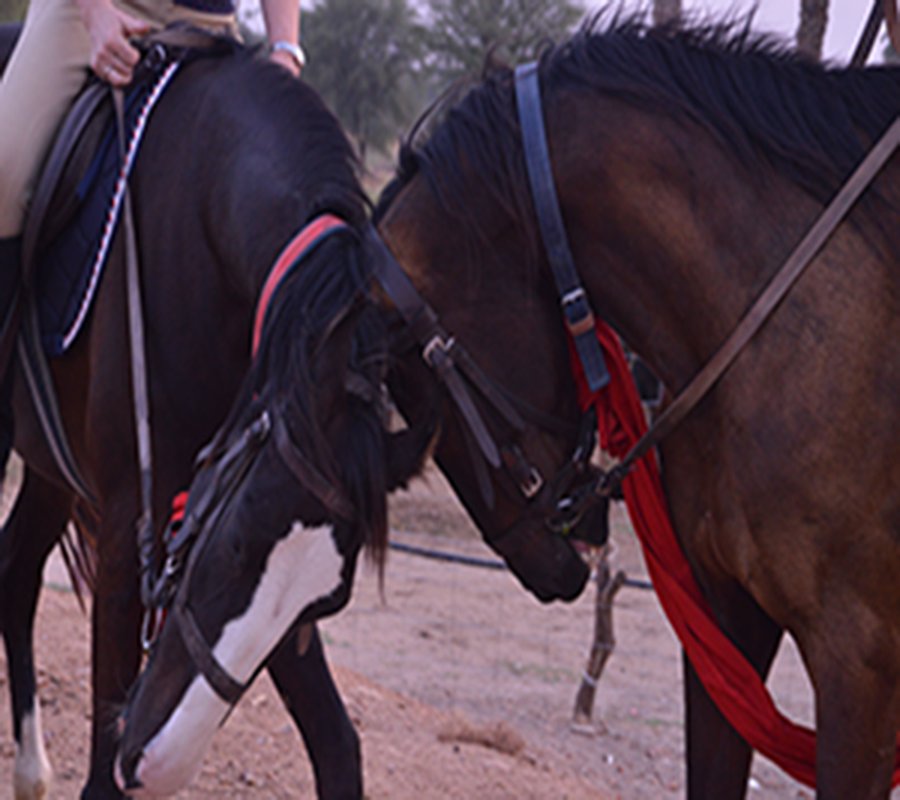 As soon as the light strikes upon the sky we meet at the Stud Farms which is just a short drive away from Jaipur, Get introduced to the ride captain, Perpetuating the deep insights about the exuberance of the village life and the traditional kinship of the rural Rajasthan, you are welcomed with the hot mesmerizing cut of traditional Indian Masala Chai.
Over the tea will discuss some of the dos and don’ts followed by the briefing about the ride, route and Horseback trailswe will be taking.
6:30 am
Prepare our horses
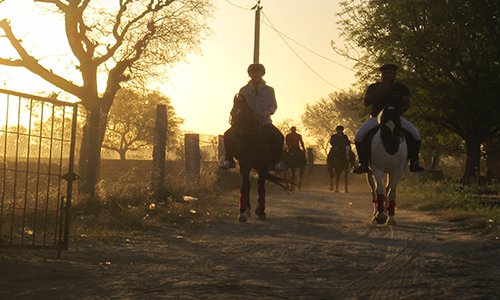
We prepare our horses to saddle them up with the essential equipment. We get time to familiarize ourselves with the Indigenous breed of Marwari Horseswhile practicing in the arena the tour leader will help us understand the some more unique features of Marwadi horses and how to ride in different styles, so you will be comfortable and confident with this exuberant Marwari horse for the entire adventure. [ /timeline_item]
7:00 am
The Ride Begins

The Ride Begins with slow walks through the pastoral paths, to master the walk it’s important to relax in the saddle. We trot on these pompous horses through the open fields as the cold breeze is brushing against us. Amidst the lush green fields, we take a short stop at a house for our horses to drink some water while we enjoy some freshly picked fruits from the fields and a hot cup of tea.
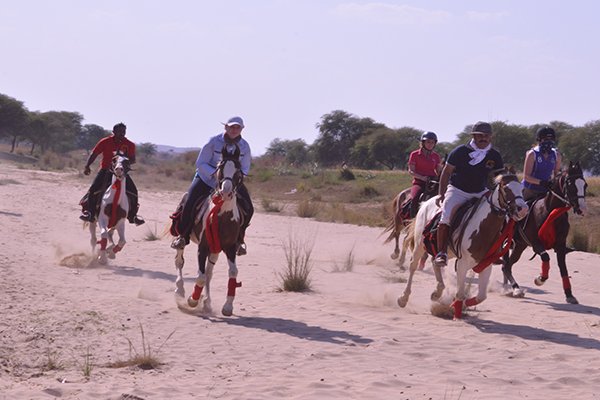
We then continue to ride through the village. In this beautiful morning, we will see how the rural India wakes up and continue their morning chores. We then get the horses canter into the sandy river beds heading into the village farmlands where the village folk are exhilarated at the sight of these majestic animals galloping through the fields. One may feel like regal Maharaja of the ancient era who has come to check if everything is running fine in his territory. Moreover, the ride in the countryside or to the off-beaten trails offer ample excitement.
After which we head out for a long trail in which we canter and gallop through the sandy paths and explore the exotic trails of the countryside of Rajasthan.
9:30 am
Ride back to the Stud Farms

Towards the end of this exquisite journey of Horse riding in Rajasthan countryside, we reach our Farms in breakfast time, Cheer up your horses before dismounting and enjoy the sight of horses wallowing on ground as we release them in the arena again, while the breakfast is being served we discuss the enigmatic tales and folklore that surrounds this area.
Extending the chitter-chatter we shall get ready to drive back to the Pink city with amazing memories and stories of horse riding tour to take back home.
As the lovely time spent with Marwari horses, we part ways with a souvenir for you to show your friends back home when you share your Rajasthan memories.
 Inclusions:
|
Terms and Conditions :
|
Package Cost
–INR: 12,500 Per Person
Minimum number of guests – 02


You May Also Like
Evening Heritage Walk Tour of Jaipur
"The Twilight Magic of Pink City" The
Ride to Galta Ji - (The Monkey Temple)
A Adventure Ride to Galta temple complex
Tour Reviews
An amazing horse safari
We had an excellent time in Jaipur with this tour company. Kush was excellent at communicating with us and escorting us to the farm. The horses were extremely well taken care of, beautiful Marwari horses with pointed ears. The farm itself was homely, everyone there was extremely welcoming and it felt like home. Dp hosted us and ensured everything ran smoothly, I couldn’t fault his hospitality and love towards the horses. more
The perfect day for a horse lover!
Khushal was incredibly helpful in setting up our day and making sure it was one to remember. We were traveling to India for my best friend’s 50th birthday and as she is an avid rider and lover of horses this seemed like the perfect adventure. more
Excelente paseo a caballo por las afueras de Jaipur
Disfrutamos mucho con el paseo a caballo. Los caballos son excelentes, de raza autóctona Marwari (Rajasthan).
Posteriormente visitamos un campo de polo y pasamos un magnífico rato. La atención y el desayuno fueron fenomenales. Khush es un excelente anfitrión. More
While in Rajasthan we (my husband and I and our two girls of 14 and 12) were keen to try and find a place to ride. It would have been wonderful to go for some days on a horse safari, but we hadn’t much time, so settled this time on going for a shorter ride. I’m so happy we came across Khush at Le Tour de India and DP Bana and his stud farm. We were taken in as friends to join a wonderful morning ride through villages and fields outside Jaipur. It was a completely different and wonderful experience to ride the sensitive, spirited and forward-going Marwani horses. Much care was taken by the captain leading the ride to ensure that everyone was managing with their mounts. When we returned after a great ride we sat under the canopy to enjoy a lovely spread for breakfast, and then had a great time getting on a couple of the fantastic polo ponies they have at the stables, and trying to play some polo – so much fun! Aside from the wonderful horses and riding, what also made this such a special experience was the warmth and friendliness of all those involved. Khush from Le Tour de India, who organised the morning ride was as helpful as it’s possible to be. I had mentioned to him when we were organising our trip that we’d love to see a polo match while we were in Jaipur, and he written back to say that the season was unfortunately over. But the day we arrived in Jaipur he wrote and surprised us by saying that he had set things up for us to go and watch a match that evening! Great fun to go to the polo ground and take it all in. DP Bana, who met us and looked after us like family at the polo match and the next day at his stud farm from where we went on our morning ride, was just so generous and warm in including us and introducing us to his friends, who also joined us the next day for the morning ride. Altogether very special, as it felt as though we made a real connection with each other in just a short time. Way over and above the usual tourist experience. Thank you all. Very much hope to see you again.
Leave a Review